Essential by Jamie K McCallum
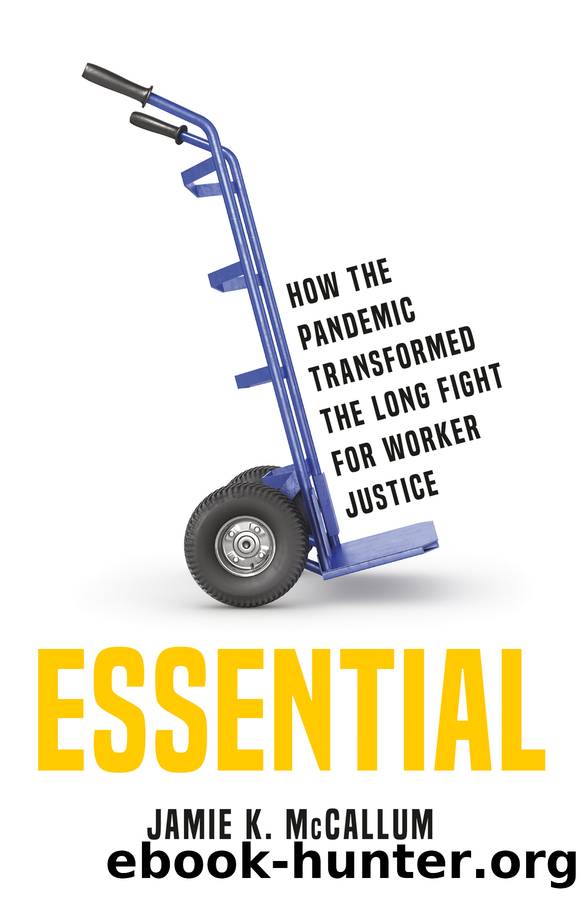
Author:Jamie K McCallum [K, Jamie McCallum]
Language: eng
Format: epub
Publisher: Basic Books
Published: 2022-11-15T00:00:00+00:00
This history has perhaps never mattered more than during the fall of 2021, given that the ongoing labor shortage was accompanied by another anomalous curiosity of the pandemic economyâa strike wave. By January 2021, six workers at the Hunts Point Produce Market had died of COVID. Described as the ânerve centerâ of New York Cityâs food supply, the market supplies more than half of the fresh produce that New Yorkers consume. To compensate for the risks associated with working through the pandemic, employees launched the first strike in the pandemicâs second year. They wanted an extra dollar per hour and more PPE. Some strikers said that although they worked to put food on the tables of the cityâs residents, their own kids sometimes went hungry. After a week of raucous pickets that drew major support from the Left, they settled on a $.70 raise, their largest in thirty years.36
Small walkouts and protests erupted throughout 2021. But most establishment labor leaders seemed focused on what Biden would be able to do to help unions, or on convincing Joe Manchin to switch sides on the filibuster debate. Neither plan was destined to win.
In the meantime, militant action was brewing among the rank and file. In the fall of 2021, workers went on offense. Ten thousand workers walked off the job at John Deere plants across Illinois and Iowa. They joined the monthslong strike at Warrior Met Coal in Alabama and the nursesâ strike at Saint Vincentâs in Worcester, led by Marlena, whom we met in Chapter 3. Food workers at Frito-Lay, Nabisco, and Kelloggâs were on strike over long hours, bad conditions, and low pay. There were graduate student workers on strike at Harvard University, as well as symphony musicians in San Antonio and whiskey makers in Kentucky, shutting down orchestras and bourbon production. By the end of October 2021, taxi drivers in New York City were on the second week of an indefinite hunger strike in the wake of nine driver suicides. Almost sixty thousand camera crew workers in Hollywood had authorized a strike, as well as thirty-seven thousand healthcare workers at Kaiser.
What was going on? As we saw in Chapter 2, there was a conflict between essential workers and their unemployed brethren, whom they saw as unfairly safe from the virus while the rest of them were risking everything to keep society running. As vaccines became more common, and the general public more accustomed to mingling, proximity to risk slowly became less important to the development of essential worker class consciousness. So, perhaps, did politics, the other stumbling block to working-class consciousness, as men in MAGA hats joined younger workers from Bernieâs movement on some of the major picket lines.
As we saw in Chapter 3, large strikes werenât common during the first year of the pandemic, yet that year was punctuated by diverse labor actions, many by nonunion workers, or seemingly spontaneous walkouts, known as âwildcat strikesâ because they werenât officially sanctioned by workersâ unions. There was a lull in the action after the economy began reopening.
Download
This site does not store any files on its server. We only index and link to content provided by other sites. Please contact the content providers to delete copyright contents if any and email us, we'll remove relevant links or contents immediately.
The Secret History by Donna Tartt(19086)
The Social Justice Warrior Handbook by Lisa De Pasquale(12190)
Thirteen Reasons Why by Jay Asher(8909)
This Is How You Lose Her by Junot Diaz(6885)
Weapons of Math Destruction by Cathy O'Neil(6279)
Zero to One by Peter Thiel(5801)
Beartown by Fredrik Backman(5754)
The Myth of the Strong Leader by Archie Brown(5507)
The Fire Next Time by James Baldwin(5442)
How Democracies Die by Steven Levitsky & Daniel Ziblatt(5218)
Promise Me, Dad by Joe Biden(5153)
Stone's Rules by Roger Stone(5087)
A Higher Loyalty: Truth, Lies, and Leadership by James Comey(4960)
100 Deadly Skills by Clint Emerson(4924)
Rise and Kill First by Ronen Bergman(4788)
Secrecy World by Jake Bernstein(4752)
The David Icke Guide to the Global Conspiracy (and how to end it) by David Icke(4717)
The Farm by Tom Rob Smith(4507)
The Doomsday Machine by Daniel Ellsberg(4490)
